
Sobha OneWorld Location: Hoskote in 2026 and 2031
Sobha OneWorld’s location story is a 2026-to-2031 story. In 2026, Hoskote is still an emerging East Bangalore market with stronger highway logic than neighbourhood maturity. By 2031, the buyer is hoping for a more complete residential ecosystem supported by NH-75, STRR, industrial activity, Whitefield spillover, large township deliveries, and better peripheral infrastructure. The location decision therefore requires two maps: the map of today and the map of likely daily life at possession. For location reading, Sobha Sacred Grove by the Lake keeps the context local: commute anchors, school access, hospital reach, retail convenience, and last-mile movement decide whether the address works.
It is worth seeing how far the same developer's map extends. The contrast is a reminder that a builder brand travels but a location does not, and that the daily-life test has to be run separately for each address.
The project is positioned in Kattamanallur, Hoskote, near the Hoskote Toll Plaza and NH-75 corridor. Whitefield, KR Puram, Kadugodi, Budigere Cross, the airport side via regional roads, and industrial/logistics belts all form part of the wider catchment. That does not make every commute easy; it means the site sits where infrastructure can meaningfully change the residential equation over time.
Sobha’s Hoskote market writing highlights industrial activity, transit upgrades, urban expansion, STRR, Bangalore-Chennai Expressway, and the eastward spread of Bengaluru. Those are real macro drivers. But a homebuyer should still translate them into daily questions: how long is the school run, where is the nearest reliable hospital, what happens in peak-hour traffic, how far are premium retail and entertainment options, and how comfortable is the route after dark or during rain?
Hoskote is not Whitefield today. That is both the opportunity and the caution. Mature locations command higher prices because they already have offices, malls, schools, hospitals, restaurants, metro access, rentals, and resale depth. Hoskote offers a lower maturity base and the possibility of appreciation as infrastructure and rooftops increase. Buyers should be honest about whether they want a developed ecosystem now or are comfortable waiting for one.
The most balanced location reading is that Sobha OneWorld can work well for buyers whose job, family, and investment horizon align with East Bangalore’s next growth ring. It is less suitable for people who need central-city convenience, immediate metro access, or a proven premium school/mall ecosystem at the doorstep from day one.
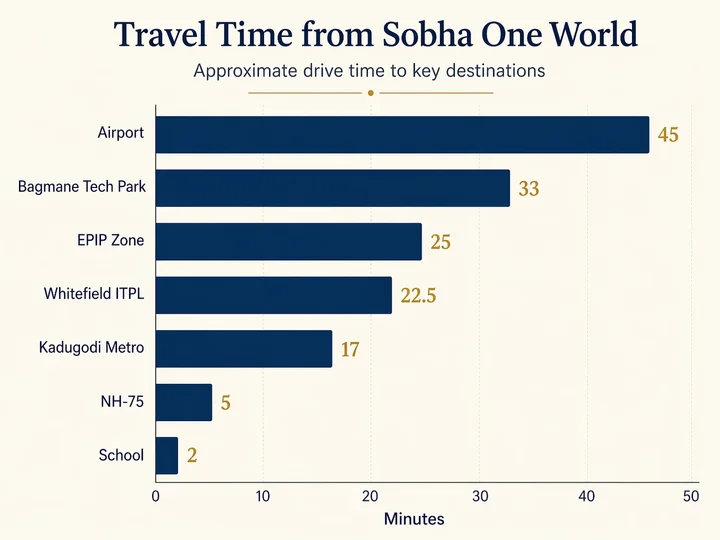
Sobha OneWorld Location Map: Hoskote Connectivity at a Glance
The developer location map below sets out the connectivity pitch in one frame: Old Madras Road (NH-75) access, the Hoskote Junction, Orion Uptown Mall, the Bangalore CBD drive, and nearby junctions at Kattamanallur, Petanahalli, and Huskuru. Read it as the marketing claim, not as a verified commute. Every drive-time number on it should be checked at your own peak hour from the actual residential gateway before treating it as a feature of the home.
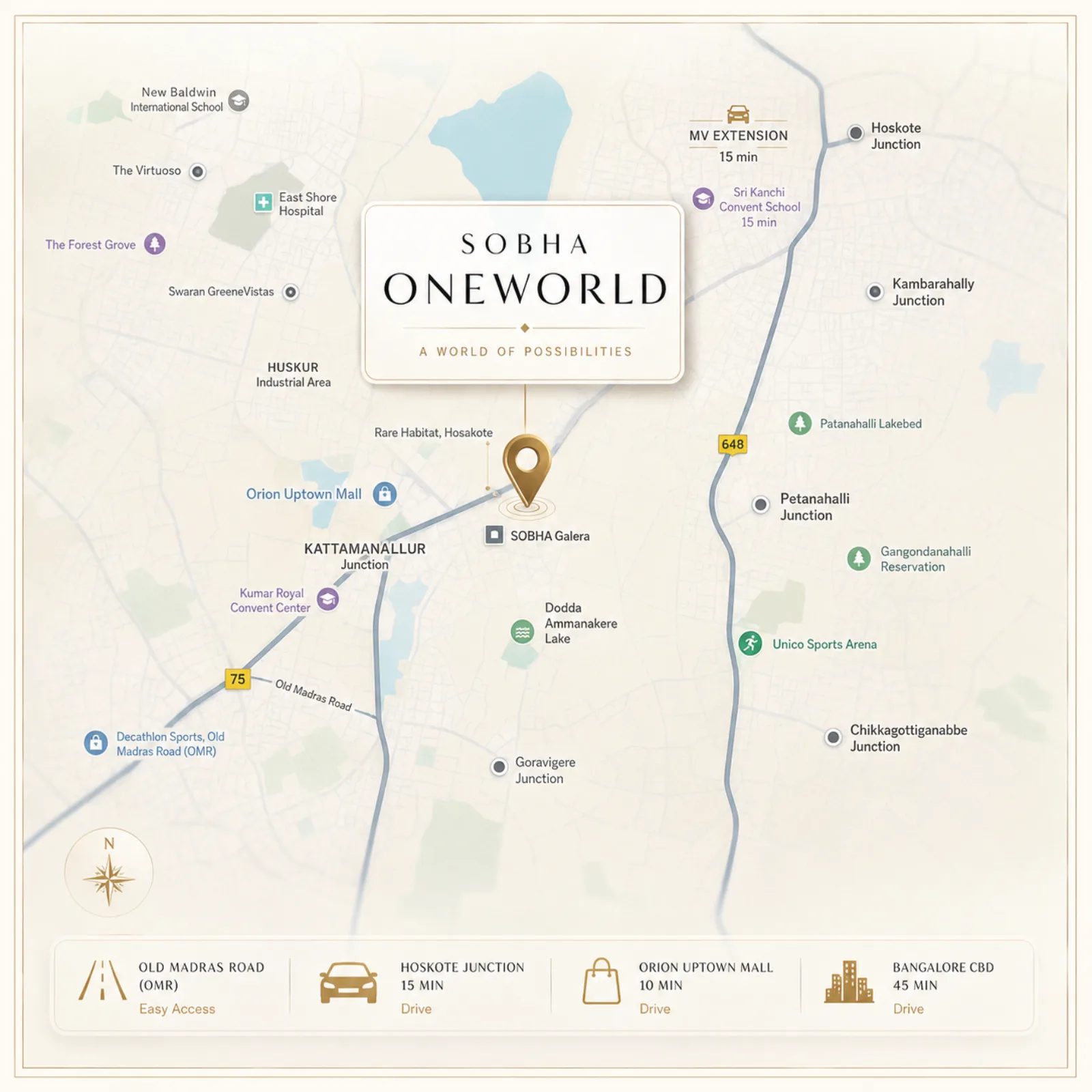
Use the map as a checklist, not a conclusion. For each labelled landmark - schools, hospital, mall, sports arena, lake - confirm the specific name, the actual road route from the residential gateway (not the sales-office entry), the peak-hour drive time, and whether the route depends on a service road, U-turn, or toll-plaza crossing that the map glosses over. The neighbourhood is shown as a balanced semi-urban belt; on the ground it is still an emerging corridor with uneven last-mile maturity.
The map also does not show the internal site layout, plot or tower boundaries, entry/exit points, or phase boundaries - those live on the master plan and key plan. Treat this drawing strictly as a location-advantage summary, and pair it with a real Google Maps drive at the times of day your household will actually use the route.
Sobha OneWorld Connectivity: NH-75, STRR and Whitefield Access
| Destination / route | Planning relevance | Buyer caution |
|---|---|---|
| NH-75 / Old Madras Road | Primary road spine for Hoskote to KR Puram and Whitefield orbit | Peak-hour bottlenecks and toll/junction delays can change travel time. |
| Whitefield / ITPL side | Main employment and rental-demand reference for many buyers | Actual commute depends on office location, shift timing, and route choice. |
| STRR / NH-648 network | Regional connectivity and logistics/airport-side movement driver | Completion and access benefits should be verified against current road status. |
| Bangalore-Chennai Expressway / NE7 | Macro growth and interstate logistics catalyst | Useful for region value; less relevant to daily school/office commute. |
| Kadugodi / Whitefield metro orbit | Current metro anchor for East Bangalore | Hoskote itself is not a metro-served micro-market today. |
| Airport reach | Regional-road advantage compared with some southern corridors | Travel time can vary heavily by chosen route and traffic conditions. |
NH-75 is the immediate location strength. It gives Hoskote a clear connection to East Bangalore rather than leaving it dependent on narrow internal roads. For buyers working in Whitefield, Kadugodi, ITPL, KR Puram, or parts of ORR, the corridor can be practical if route timing is favourable. The buyer should still test the route during actual commute windows because morning and evening traffic behave very differently from weekend site-visit traffic.
STRR is a major long-term catalyst because it improves regional movement around Bengaluru’s satellite towns and logistics corridors. Sobha’s Hoskote guide notes the Dobbaspete-Hoskote stretch and broader connectivity impact. For a residential buyer, STRR is more of an appreciation and regional-access factor than a replacement for a short office commute. It can help Hoskote’s economic base and movement patterns, but the buyer should not treat it as proof that every daily trip becomes easy.
The Bangalore-Chennai Expressway strengthens the macro case. It places Hoskote in a larger interstate movement corridor and supports warehousing, industrial, and logistics demand. This can improve long-term land value and economic activity. However, a family choosing a school or office route should not confuse expressway access with neighbourhood convenience. Macro infrastructure and daily livability are related, but not identical.
Metro is the most sensitive claim. Whitefield’s Purple Line has changed East Bangalore’s mobility, and future extension conversations can help sentiment. But as of 12 May 2026, buyers should treat a Hoskote metro extension as upside unless there is a fully approved, funded, and time-bound plan. A purchase should work without assuming metro at the gate.
The best connectivity due diligence is personal. Drive from the site to your office at your real office time. Drive to the school you would actually consider. Drive to a hospital at night. Check the route during rain if possible. Ask residents in nearby communities, not only channel partners. The project’s location can be strong for one household and inconvenient for another, depending on routine.
Sobha OneWorld Schools, Hospitals, Retail and Daily Life
The social infrastructure question is where Hoskote’s transition becomes visible. Basic schools, clinics, local markets, and highway access exist, but premium schooling, specialty hospitals, malls, and dense food/retail choices are stronger closer to Whitefield, KR Puram, and Budigere Cross. A buyer should separate immediate essentials from aspirational lifestyle infrastructure. The project can still be a good purchase if essentials are manageable and the buyer expects the wider ecosystem to improve by possession.
School choice is personal and often non-negotiable. A project can be five minutes from a school and still not solve a family’s education needs if the curriculum, reputation, commute, admission, language, or extracurricular expectations do not match. Families with children should identify two or three realistic schools today and test the commute at school timings. They should also ask whether any internal school or education parcel is a committed township feature or only a long-term possibility.
Healthcare should be mapped by urgency. Nearby clinics and smaller hospitals may handle routine care, but families should identify the nearest reliable emergency hospital, maternity care, pediatric care, and specialty facility. Time to healthcare matters more than distance on a brochure. If the route crosses busy junctions or highway sections, the buyer should be realistic about night-time and peak-hour access.
Retail and entertainment are lifestyle comfort indicators. Hoskote’s everyday retail base is improving, but buyers expecting Phoenix Marketcity-style retail or Whitefield restaurant density at the doorstep may feel the location is still early. Internal convenience retail in a large township can reduce friction, but it does not fully replace a mature urban high street or mall ecosystem.
Daily life also includes domestic help availability, delivery coverage, internet service, cab availability, school transport, repair services, pet care, and safety after dark. These are rarely in project brochures, yet they shape the first year after possession. Buyers should ask nearby residents and service providers how the area works today and how it is changing.
The balanced social-infra view is that Sobha OneWorld is a future-comfort play. It should improve as rooftops increase and developers cluster in the corridor. But families moving at possession should still prepare for a location that may be functional before it is fully polished.
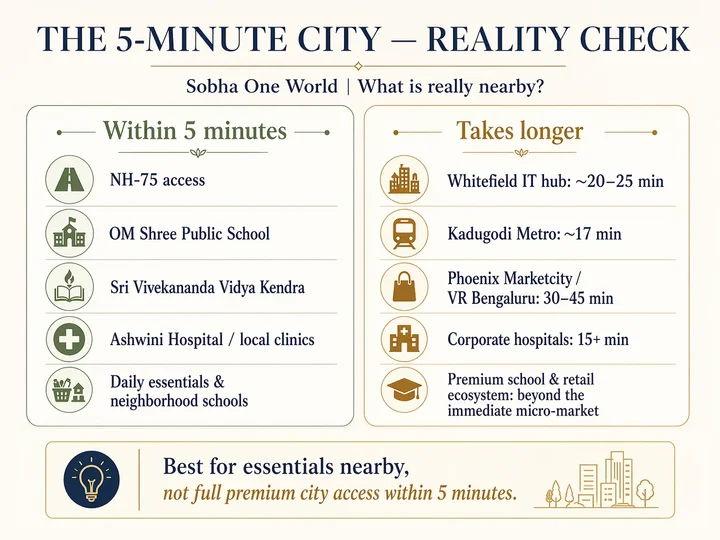
Sobha OneWorld Water: Cauvery Stage VI and Township Planning
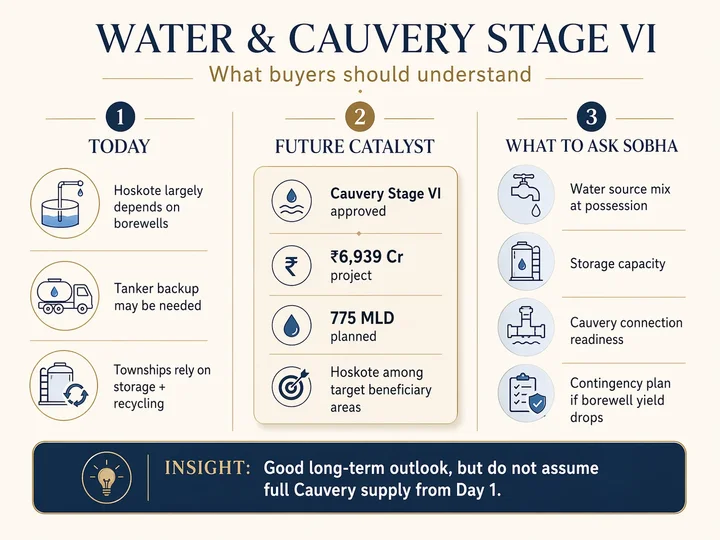
Water is one of the most important Hoskote questions because a 5,000+ unit high-rise phase needs reliable daily supply, storage, treatment, and reuse. Peripheral Bengaluru locations often rely on a mix of borewells, tankers, treated water, rainwater harvesting, and future municipal connections. A buyer should not accept “24x7 water” as a complete answer. The useful answer is the source mix, design capacity, backup plan, and timeline for municipal connection.
Cauvery Stage VI is an important public-policy signal. Recent coverage says Karnataka approved a Stage VI project intended to support Bengaluru’s fast-growing outskirts and benefit a large population. Hoskote is part of the broader peripheral-growth conversation. This improves the long-term water narrative, but it does not guarantee that every apartment in Sobha OneWorld receives Cauvery water from day one of possession. Government approvals, tendering, trunk lines, last-mile distribution, project connections, and commissioning can take time.
For Sobha OneWorld, the buyer should ask what happens under three scenarios. Scenario one: Cauvery infrastructure and project connection are available by possession. Scenario two: bulk infrastructure is progressing but not fully connected to the township. Scenario three: municipal supply is delayed and the project must operate on internal sources and tankers for longer. A credible water plan should handle all three scenarios.
STP and treated-water reuse are part of the answer. In a large township, treated water can support flushing, landscaping, and some non-potable uses, reducing pressure on fresh water. But STP capacity, odour control, maintenance, and distribution quality matter. A poorly run STP can become a quality-of-life issue. A well-run STP can make the township more resilient.
Ask direct questions before booking: how many borewells are planned, what is the estimated daily demand, how many days of underground and overhead storage are designed, what tanker backup is assumed, whether Cauvery-ready plumbing is built into the internal network, where STPs are located, and how treated water is reused. These questions are practical, not negative. They are exactly what a serious buyer should ask for a township of this scale.
The final water view is conditional but not pessimistic. Sobha’s scale and brand may help with planning and engagement, and Stage VI gives a better long-term backdrop than a location with no public-water pathway. Still, the buyer should treat water as a verification item until the project-level source plan is in writing.
Compare buyer fit Contact usSobha OneWorld Location Decision: Daily Routine Test
The best way to test Sobha OneWorld’s location is to build a weekly routine map. Start with work. Where do the earning members travel on Monday morning? What is the route at 8:30 AM, not 2 PM? Is there a metro-and-cab combination that actually saves time, or does it add friction? If one spouse works in Whitefield and another works near Manyata or Bellandur, the same location may feel very different to each person.
Next map school and childcare. If children are already enrolled, test that exact commute. If children are future planned, identify realistic schools rather than the nearest school on a map. Admissions, curriculum, language, fees, bus routes, and peer group matter. A five-minute school is useful only if it is a school the family would genuinely choose.
Then map healthcare. Identify the nearest clinic for routine needs, the nearest reliable emergency hospital, and the hospital you would use for specialty care. Drive the route once in normal traffic and once in a busier window if possible. Hoskote can be practical, but healthcare comfort is a personal threshold.
Map groceries, repairs, domestic help, and deliveries. In a mature neighbourhood these are invisible conveniences. In an emerging corridor they can be uneven. A large township may attract better services over time, but early residents should be prepared for some friction. Ask nearby residents what delivery apps, cab services, internet providers, and domestic-help networks actually work today.
Map weekends too. If the family’s weekend life is built around Whitefield malls, restaurants, sports classes, friends, or religious/community centres, the distance matters. If the family prefers township amenities and quieter weekends, Hoskote may feel comfortable sooner. The right location is the one that matches actual behaviour, not aspirational behaviour.
Finally, repeat the test against alternatives. Compare Sobha OneWorld with Godrej Parkshire, Budigere Cross, a Whitefield resale, and one non-East-Bangalore option using the same weekly routine. This makes the decision fair. A project can look far on paper but work for your routine; another can look close but fail during peak hours.
The location decision should end with a simple sentence: “This works for our weekdays because...” If the buyer cannot complete that sentence with evidence from route tests, school mapping, and service checks, the location still needs more research before booking.
Weekday test
Drive office, school, and hospital routes at real timings before treating brochure minutes as reliable.
Service test
Check cab, delivery, broadband, domestic help, groceries, and repair access around the actual site.
Alternative test
Compare Hoskote with Budigere and Whitefield using the same family routine, not just the same price.
Sobha OneWorld Location Red Flags and Green Flags
A green flag is route redundancy. If the project can reach key destinations through more than one practical route, residents are less vulnerable to one junction, toll delay, or roadwork. Ask local drivers which routes work during peak hour and which routes fail during rain. A location with only one comfortable route is riskier than it appears on a map.
A green flag is clustering by reputed developers. Sobha, Godrej, and other branded launches in the Hoskote-Budigere belt suggest that multiple developers see long-term demand. Developer clustering can attract retail, services, schools, and buyer attention. The caution is supply: many launches also mean future resale competition, so entry price and unit selection still matter.
A green flag is improving infrastructure that is already visible or under execution. Existing NH-75 access is tangible. STRR sections and expressway progress can be tracked. Proposed metro narratives are less certain until approvals and timelines are firm. Buyers should separate visible infrastructure from possible infrastructure.
A red flag is a commute that only works in sales-office timing. If the project feels well connected on a weekend but fails during weekday peak hours, the location may not suit an end user. Always test routes at the exact time your household will use them. If you cannot test now, mark commute as unresolved.
A red flag is vague water language. For a large township, “adequate water” is not enough. Ask for the planned source mix, storage capacity, STP reuse, tanker backup, Cauvery-readiness, and contingency if borewell yields reduce. Water answers should be operational, not only reassuring.
A red flag is assuming Hoskote will become Whitefield on a fixed date. Corridors mature unevenly. Some services may arrive quickly after rooftops increase; others may lag. A buyer should be comfortable with a transition period after possession rather than expecting complete maturity immediately in 2031.
Sobha OneWorld Location: Final Buyer Notes
A practical way to use this location page is to turn it into a meeting agenda. Instead of asking the sales team broad questions such as whether the project is good, ask for the exact commute, schools, hospitals, water, services, and road access details that affect your decision. Specific questions get specific answers, and specific answers are easier to compare with documents later. Within the same SOBHA Limited Bengaluru portfolio, SOBHA Hennur–Bagalur helps readers judge whether brand comfort is also matched by location, format, and budget fit.
Keep a written version history. Launch-stage projects change quickly: pricing slabs move, tower availability changes, RERA documents appear, payment schedules are refined, and amenity phasing becomes clearer. When you receive an answer, record the date, person, document name, and whether the answer came from a brochure, email, cost sheet, RERA upload, or verbal discussion.
Do not treat the first available unit as the only opportunity. Large projects often create urgency through EOI windows and preferred-unit availability, but the buyer still needs to check whether that unit fits budget, routine, floor preference, view, and resale logic. A less glamorous unit that fits the decision framework can be better than a rushed premium unit.
The key document for this page is the buyer’s own route log plus written water-source and access notes. If that document is not yet available or does not answer the question clearly, mark the item as pending rather than resolved. Pending items do not always mean “do not buy.” They mean the buyer should avoid converting interest into a binding commitment until the uncertainty is proportionate to the amount being paid.
Every Sobha OneWorld decision also has an opportunity cost. The same budget may buy a smaller but more mature Whitefield resale, a different branded Hoskote launch, a Budigere Cross apartment, a North Bangalore option, or a lower-risk ready home. The location decision is stronger when the buyer can explain why Sobha OneWorld remains preferable after those alternatives are honestly considered.
The final location takeaway is that Hoskote offers infrastructure-led upside but does not yet provide the mature convenience of Whitefield or central East Bangalore. If that trade-off is acceptable, the next step is to test weekday routines before treating the location as personally suitable. If it is not acceptable, the buyer should pause, collect more evidence, or compare a different configuration or location before paying further.
Sobha OneWorld Location: Rechecking the Area Before Agreement
Location should be rechecked immediately before Agreement of Sale, not only during the first site visit. Road works, traffic patterns, nearby construction, access routes, and service availability can change during a launch cycle. A second visit at a different time of day often reveals details the first visit misses.
Buyers should also speak to people who are not selling the project: nearby shopkeepers, drivers, residents in neighbouring layouts, school transport operators, and local service providers. They can offer practical insight into water, traffic, safety, deliveries, and area growth that does not appear in brochures.
If the household is relocating from a mature area, spend time in Hoskote beyond the project gate. Eat nearby, check grocery options, try cab booking, inspect the approach after sunset, and drive to Whitefield in traffic. A location decision becomes much clearer when it is experienced as a normal day rather than a site-tour event.
Sobha OneWorld Location: Last Practical Check
The last practical location check is to imagine the first month after possession. Where will groceries come from, who will fix an appliance, how will guests find the gate, what happens if a child is sick at night, how easy is the office route during rain, and where will the family go on weekends? If those answers feel workable, Hoskote’s future upside becomes easier to hold. If they feel uncertain, keep researching before turning interest into commitment.
Location logic does not carry between cities, and that is precisely why a second reading helps.
Sobha OneWorld Location FAQs
Where is Sobha OneWorld on the East Bengaluru map?
The site is off Old Madras Road (NH-75) at Kattamanallur, near the Hoskote Toll Gate, with the postal PIN 562114. Coordinates are approximately 13.0580967°N, 77.7716732°E. The map pin on Google Maps is https://maps.app.goo.gl/UmuzYEFwEXSTt91s7.
Which roads connect Sobha OneWorld to the rest of the city?
The site is at the junction of four major routes: Old Madras Road (NH-75), Whitefield–Hoskote Road, Budigere Road, and the Satellite Town Ring Road (STRR). NH-75 also feeds into the upcoming Bangalore–Chennai Expressway, giving the location both an intra-city and an intercity connectivity story.
How far is Sobha OneWorld from Whitefield, the CBD, and the airport?
The drive to the Bengaluru CBD is approximately 45 minutes off-peak. Whitefield and Kadugodi are the nearest large IT clusters via the Whitefield–Hoskote Road. Kempegowda International Airport is reachable via NH-75 and STRR. Always test peak-hour times yourself before relying on a brochure number.
What social infrastructure surrounds Sobha OneWorld?
Nearby anchors include Orion Uptown Mall, SOBHA Galera, ITPL Whitefield, and a cluster of schools and hospitals along the OMR–Whitefield belt. Day-to-day retail and grocery options exist around Hoskote and Kattamanallur, with social-infra density still building as the corridor matures.
Is the Hoskote micro-market mature enough for premium living?
Hoskote today is a growth location rather than a fully mature premium ecosystem. Its case rests on NH-75 access, East Bengaluru expansion, STRR, the Bangalore–Chennai Expressway, industrial and logistics activity, and Whitefield spillover. Buyers who need metro access, premium schools, or large hospitals immediately may find Whitefield-side options easier.
How should buyers test the Sobha OneWorld location before booking?
Drive from the site to your actual office at your real commute hour, test weekend routes to schools and hospitals, and check median cuts, U-turns, and service-road behaviour near the Hoskote Toll Plaza. Ask Sobha specifically how the permanent resident entry will work after completion, since temporary sales-office routes may differ from the final approach.