
Sobha OneWorld Gallery: How to Read Renders Like a Buyer
The Sobha OneWorld gallery should not be treated as decoration. Renders, elevation views, lifestyle images, floor plans, and advisory charts each answer a different buyer question. The elevation render tells you about scale and skyline ambition. The aerial township render suggests land planning and open-space hierarchy. The clubhouse and pool visuals communicate lifestyle positioning. Interior renders show finish mood, not exact handover specification. Charts translate the financial and location thesis. A useful gallery page explains what each image can prove and what it cannot. Sobha Sacred Grove by the Lake is useful when buyers are reading images for practical signals: light, approach, amenity scale, landscape maturity, and what still needs official confirmation.
Renders carry different weight across a developer's portfolio. Reading both against the same Sobha Limited track record is a good check on how much a render is really promising.
This is important because pre-launch buyers are often making decisions before construction has progressed far enough for a normal site inspection. A model flat may help with finish feel, but the actual tower, floor, view, lobby, lift core, and amenity walkways are still future promises. Visual material therefore becomes a research tool only when buyers read it alongside drawings, specifications, RERA uploads, and the current price sheet.
A render can make every project look complete, green, calm, and spacious. The buyer’s job is to ask what is fixed and what is illustrative. Is the building height accurate? Is the tower spacing shown to scale? Are the gardens part of Phase 1? Are the pool, clubhouse, and park delivered before or after the first towers? Are furniture, lighting, false ceiling, wall finishes, appliances, and balcony treatments included or only representative?
The gallery shows how Sobha OneWorld wants to position its township scale against smaller Hoskote or Budigere projects. Aerial images can support the township thesis, but scale alone does not guarantee everyday comfort. Look for shaded walking routes, vehicle-pedestrian separation, children’s zones, senior seating, clubhouse access, and visual relief between towers.
This page turns the gallery into a buyer guide. Each visual should help answer one practical question before a site visit: what is the project promising, which part is likely to influence daily life, which part needs document verification, and which part is mainly mood-setting? That approach keeps the page useful for SEO while still protecting buyers from over-reading beautiful images.
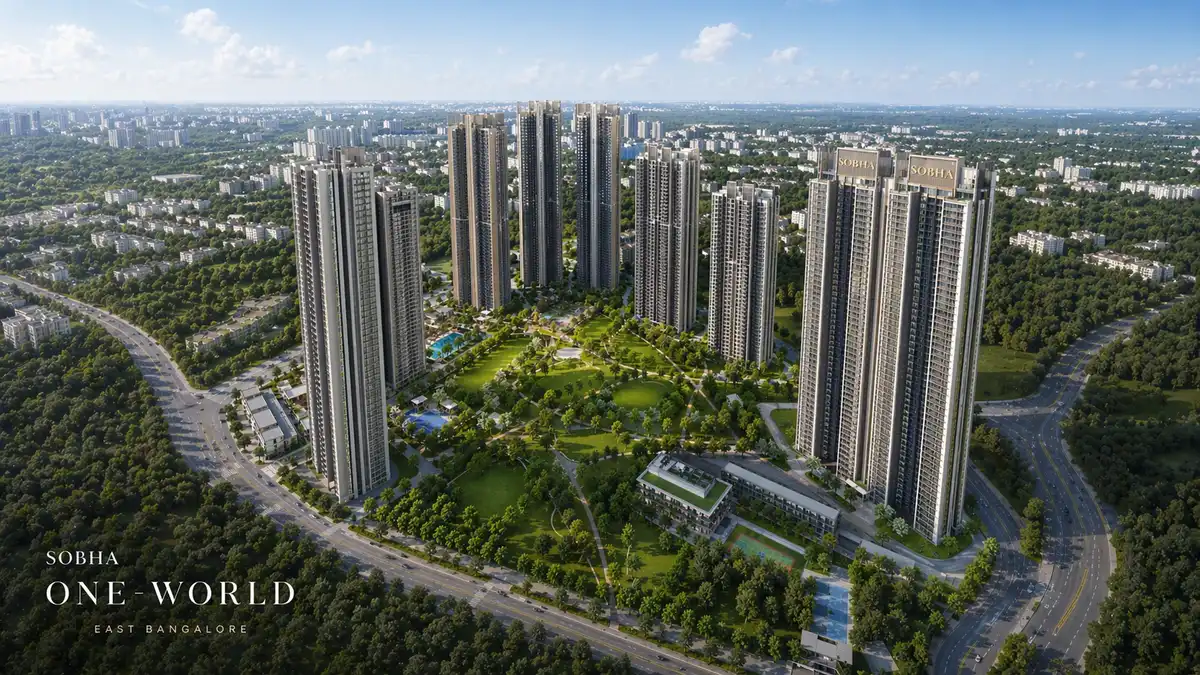
Sobha OneWorld Project Images: What They Signal
Aerial cover
Useful for understanding township ambition, but not enough to confirm phase boundaries or exact amenity delivery.
Tower elevation
Shows vertical scale and premium positioning; verify floor count, lift design, fire systems, and view premiums separately.
Central park
Signals the green-core lifestyle; ask whether the shown open area is part of Phase 1 and when it becomes usable.
Clubhouse arrival
Shows lifestyle aspiration; ask about square footage, operating capacity, access rules, and maintenance cost.
Pool retreat
Useful for resort feel; ask whether adult, kids, and leisure pools are separate and how crowding is managed.
Interiors
Indicates mood and finish language; compare with the specification sheet and model apartment, not the render alone.
The aerial township images are the most strategic visuals because they communicate the promise that Sobha OneWorld is more than a cluster of towers. They show broad planning, green pockets, tower arrangement, clubhouse position, and the sense of a destination community. The buyer should use them to ask for a numbered master plan with tower names, phase boundaries, future development parcels, entry and exit points, internal roads, utility zones, and amenity delivery dates.
The elevation image is useful for understanding the project’s high-rise identity. A 46-floor residential tower behaves differently from a 20-floor tower. It can offer stronger views and a more dramatic skyline, but it also creates questions around lift waiting, evacuation comfort, wind, service access, and floor-rise premiums. A buyer should not stop at “higher floor equals better.” The right floor is the one that balances view, cost, comfort, lift dependence, and resale preference.
The central park visual is one of the most important lifestyle images. It suggests where families walk, children play, residents meet, and towers get visual relief. The buyer should ask how much of the central green is active park, how much is visual landscape, what the walking loop length is, how shaded seating is handled, and whether later construction will disturb the area after possession.
Clubhouse and pool images should be read through a capacity lens. The visual may show calm resort-style spaces, but a township with thousands of homes needs operating rules. Ask how many residents the gym, pool, indoor games, banquet, co-working, and sports spaces are designed for. Ask whether paid booking applies for party halls or guest rooms. Ask whether children’s pool, lap pool, leisure pool, and deck seating are separate.
Interior renders are the easiest to misread. A living room render may include furniture, lights, wall treatments, decorative panels, curtains, appliances, and ceiling details that are not part of handover. Buyers should compare the image with the specification sheet: flooring, wall finish, bathroom fittings, kitchen counter provision, balcony railing, doors, windows, electrical points, air-conditioning provision, and smart-home or video-door-phone features.
The healthiest use of gallery images is to make a site-visit checklist. Print or save the key visuals and ask the sales team to mark what is included, what is indicative, what is Phase 1, and what is future phase. That simple discipline turns renders from marketing material into a practical due-diligence tool.
Sobha OneWorld Charts and Advisory Visuals
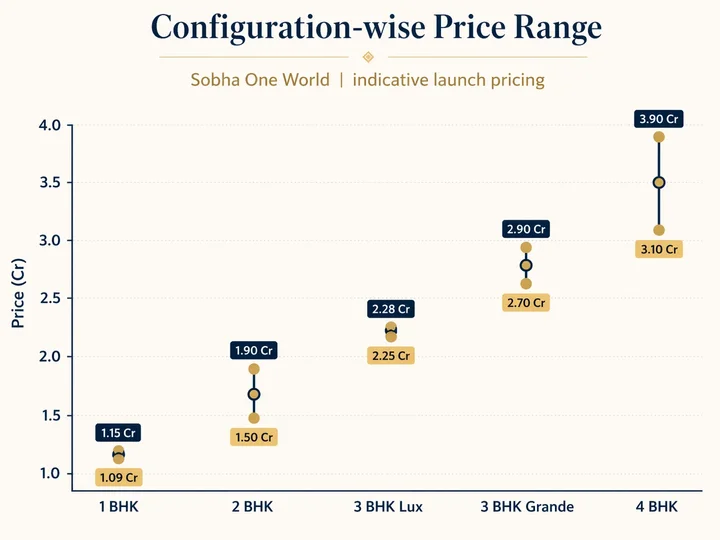
The price-range chart helps buyers see the spread between configurations, but it should not be treated as a cost sheet. A price chart compresses many variables into a clean visual: floor, tower, facing, launch slab, parking, GST, registration, clubhouse, corpus, and interiors may all sit outside the simple range. Use the chart to decide which configurations deserve a deeper cost sheet, not to finalize affordability.
The monthly outflow chart is more important for household safety. It shows that the project’s real burden is not only the final EMI after possession. Construction-linked disbursals can create a rising pre-EMI while the family continues to pay rent elsewhere. This is especially relevant for buyers currently living near their workplace in Whitefield, Bellandur, KR Puram, Kadugodi, or ORR.
The travel-time chart should be read as a baseline, not a guarantee. Hoskote access depends on NH-75, traffic at toll and junction points, peak-hour conditions, school timings, rain, and construction works. The chart is useful for comparing destinations, but buyers should drive the route at their actual office and school timings. A Sunday site visit can make a location feel easier than it will be on a Tuesday morning.
The comparison visuals are useful because Sobha OneWorld buyers rarely evaluate one project in isolation. They compare Godrej Parkshire in Hoskote, Godrej Woodscapes or Bengal Lamps in Budigere, mature Whitefield resale options, and sometimes North Bangalore or Sarjapur alternatives. A chart can show the broad axes: possession date, brand, scale, price, location maturity, and risk. The buyer still needs to decide which axis matters most personally.
The water and Cauvery visuals deserve careful reading. Cauvery Stage VI approval is a positive macro signal for peripheral Bengaluru, including regions such as Hoskote, but a government scheme does not automatically equal tap water in every apartment at possession. The buyer should ask how Sobha OneWorld plans source mix, storage, STP reuse, tanker backup, and readiness for future BWSSB connection.
Advisory visuals should not overstate certainty. A graph showing possible appreciation is not a promise. A checklist showing risk is not a rejection. The best charts help buyers slow down and ask better questions. They create structure around an emotional decision, which is exactly what a good gallery page can do when it goes beyond image display.
Sobha OneWorld Gallery Checklist Before Site Visit
| Visual item | Question to ask | Document to request |
|---|---|---|
| Aerial master plan | Which parts are Phase 1 and which are future township parcels? | Registered phase plan and site layout. |
| Elevation render | Is the exact tower height, facade, balcony treatment, and floor count approved? | Sanctioned tower drawings and RERA uploads. |
| Clubhouse render | What is committed at first possession and what opens later? | Amenity handover schedule and maintenance terms. |
| Interior render | What finishes are actually included in handover? | Specification sheet and model-flat checklist. |
| Pool / park visual | How are crowding, safety, access, and maintenance handled? | Amenity capacity note and association/maintenance assumptions. |
| Charts | Which assumptions are fixed and which are illustrative? | Dated price sheet, payment plan, and route/water verification notes. |
A gallery page becomes genuinely useful when it teaches buyers what to do next. For Sobha OneWorld, the next step is not simply to admire the visuals. It is to convert each visual into a question. The aerial view should become a phase-boundary question. The clubhouse render should become a capacity and maintenance question. The interior render should become a specification question. The price chart should become an all-in cost question.
Buyers should also keep screenshots of the visuals used during the sales discussion. If a salesperson points to a particular park, view, or facility while describing the unit, ask them to identify it on the official layout and confirm whether it is part of the registered phase. This avoids a common misunderstanding where broad township imagery is mentally attached to an early tower without legal commitment.
For families, the most important visuals are often not the grandest ones. A shaded walking path, safe children’s play area, practical lobby, clean basement, useful utility balcony, and usable bedroom shape matter more over ten years than a dramatic evening render. The gallery should therefore be used for both aspiration and friction detection.
For investors, visuals matter because future tenants and resale buyers respond emotionally to the look and feel of a community. A strong entrance, clean towers, active clubhouse, and pleasant green areas can improve marketability. But investors should still prioritize delivery, maintenance, rent demand, and competing supply over render beauty.
The final gallery rule is simple: enjoy the images, but verify the claims. Sobha OneWorld’s visual set supports a premium township story. The purchase decision should rest on the version of that story that appears in official documents, construction progress, and a budget that survives real life.
Read master plan Contact usSobha OneWorld Gallery: Buyer Scenarios and Visual Red Flags
Different buyers should read the same gallery differently. An end user with children should look at the central park, play areas, lobby routes, basement access, and school-bus logic. An investor should look at the images that future tenants and resale buyers will respond to: entrance identity, clubhouse, pool, tower elevation, and unit interiors. A senior-friendly buyer should look beyond glamour and ask whether the visual set shows shaded walks, quiet seating, smooth surfaces, lift access, and medical convenience.
The first visual red flag is excessive perfection. If every image shows mature landscaping, empty roads, no neighbouring construction, and no service areas, the buyer should remember that early possession may look different. Landscaping takes time to mature, later phases may remain active, and service functions must exist somewhere. Ask to see the practical drawings, not only the hero images.
The second red flag is missing scale. A clubhouse render may look spacious because only a few people are shown. A pool deck may look calm because it is staged like a resort. A park may look large without showing tower distance. Buyers should ask for dimensions, resident capacity, and where the visual sits on the master plan. A render without scale is mood, not evidence.
The third red flag is interior over-specification. If the image shows wood panelling, designer lights, premium curtains, movable furniture, appliances, artwork, false ceiling, or decorative storage, assume those are staging unless the specification sheet says otherwise. This is not a criticism of the render; it is how real estate visuals usually work.
The fourth red flag is a view that cannot be matched to a tower. A buyer may fall in love with an open green or skyline view, but their actual unit may face another tower, a road, a future phase, or a service area. Ask the sales team to mark the exact stack and expected view direction on the layout. If the answer is vague, do not pay a view premium blindly.
The gallery can also reveal strengths. If the visuals consistently show pedestrian spaces, large green areas, basement parking, active clubhouse functions, and practical interiors, they support the township positioning. The buyer’s task is to convert that support into verification: which image corresponds to which drawing, which feature is included, when it is delivered, and how it is maintained.
End-user reading
Look for school-bus flow, children’s safety, daily walking, tower access, utility spaces, and long-term comfort.
Investor reading
Look for images that will improve tenant appeal, resale confidence, and project identity after possession.
Verification reading
Match each render to a plan, specification, phase, cost sheet, or site-visit question.
Sobha OneWorld Gallery: Match Every Image to a Document
The most useful gallery exercise is image-to-document matching. For the aerial view, request the master plan and phase layout. For the elevation view, request sanctioned tower drawings when available. For interior renders, request the specification sheet. For pool and clubhouse visuals, request the amenity schedule and maintenance assumptions. For charts, request the underlying dated cost sheet or source note. Across the SOBHA Limited portfolio, Sobha Boulevard is relevant because brand confidence still has to be tested against each city's address, timeline, cost sheet, and buyer profile.
This process does not make the gallery less enjoyable. It makes it more valuable. A buyer can still be inspired by the scale, architecture, and lifestyle promise while asking whether each visual is contractual, indicative, future-phase, or purely illustrative. Clear classification reduces disappointment later.
When reviewing exterior images, ask about final facade materials, balcony railing, window systems, AC outdoor-unit placement, lighting, and maintenance access. A render often simplifies service details. The final building must handle rain, dust, heat, cleaning, safety, and long-term facade upkeep. These details affect how premium the project feels after five monsoons, not only at launch.
When reviewing landscape images, ask about tree maturity, irrigation, STP-treated water use, shaded seating, pet areas, children’s zones, and monsoon drainage. Landscape renders usually show mature greenery from day one, but real landscapes develop over time. Ask what is planted at handover and what matures later.
When reviewing interior images, separate architecture from decor. Architecture includes room size, window position, balcony access, kitchen relationship, bathroom placement, and storage walls. Decor includes furniture, lights, curtains, panels, art, and styling. Buyers purchase architecture and specifications; decor is usually their own cost.
When reviewing charts, check assumptions. A price chart may use base prices; an EMI chart may use a rate assumption; a travel chart may use non-peak timing; a water chart may use policy announcements. Every chart is useful when assumptions are visible and dangerous when assumptions are hidden.
Sobha OneWorld Gallery: Final Buyer Notes
A practical way to use this gallery page is to turn it into a meeting agenda. Instead of asking the sales team broad questions such as whether the project is good, ask for the exact render status, inclusion, specification, and phase mapping details that affect your decision. Specific questions get specific answers, and specific answers are easier to compare with documents later.
Keep a written version history. Launch-stage projects change quickly: pricing slabs move, tower availability changes, RERA documents appear, payment schedules are refined, and amenity phasing becomes clearer. When you receive an answer, record the date, person, document name, and whether the answer came from a brochure, email, cost sheet, RERA upload, or verbal discussion.
Do not treat the first available unit as the only opportunity. Large projects often create urgency through EOI windows and preferred-unit availability, but the buyer still needs to check whether that unit fits budget, routine, floor preference, view, and resale logic. A less glamorous unit that fits the decision framework can be better than a rushed premium unit.
The key document for this page is the specification sheet, master plan, and image-to-feature explanation from the sales team. If that document is not yet available or does not answer the question clearly, mark the item as pending rather than resolved. Pending items do not always mean “do not buy.” They mean the buyer should avoid converting interest into a binding commitment until the uncertainty is proportionate to the amount being paid.
Every Sobha OneWorld decision also has an opportunity cost. The same budget may buy a smaller but more mature Whitefield resale, a different branded Hoskote launch, a Budigere Cross apartment, a North Bangalore option, or a lower-risk ready home. The gallery decision is stronger when the buyer can explain why Sobha OneWorld remains preferable after those alternatives are honestly considered.
The final gallery takeaway is that visuals are useful for understanding aspiration but weak as evidence unless matched to documents. If that trade-off is acceptable, the next step is to carry the image checklist into the model-flat visit and site discussion. If it is not acceptable, the buyer should pause, collect more evidence, or compare a different configuration or location before paying further.
Sobha OneWorld Gallery: Photo Review Notes for Repeat Visits
Review the gallery before and after every site visit. Before the visit, use it to decide what to inspect. After the visit, use it to mark what was confirmed, what remains unclear, and what felt different on the ground. This habit is especially useful when construction is early and many visual promises are still represented through renders.
If the sales team updates images during the launch cycle, save the older and newer versions. Changes in tower views, amenity placement, landscape emphasis, or interior styling can reveal how the project story is evolving. Version changes are not automatically negative, but they should prompt buyers to ask what changed in the actual plan.
For family buyers, share the gallery with everyone who will live in the home. Different people notice different things: children notice play spaces, parents notice commute and storage, seniors notice walking comfort, and investors notice resale appeal. A good visual review includes all these perspectives.
Sobha OneWorld Gallery FAQs
What does the Sobha OneWorld gallery show?
The gallery includes the Sobha OneWorld tower elevation along Old Madras Road, the 48-acre Phase 1 master plan with 14 wings and amenity legend, and the community clubhouse with the OneWorld Plaza render. Internal amenity zones such as the pool, multi-sport courts, and Oasis Trail also appear in the brochure visuals.
Are the Sobha OneWorld gallery images final or indicative?
Renders show design intent rather than constructed reality. They typically include staged furniture, mature landscaping, perfect weather, and a fully populated township that will not exist on the first day of possession. Use them as a checklist for what to verify on the specification sheet and sanctioned plan.
How should buyers use the Sobha OneWorld gallery before booking?
Treat each image as a question rather than proof. For every render ask whether the feature is part of registered Phase 1, whether it appears in the sanctioned plan, when it will be delivered, and whether the visual includes finishes that are only illustrative. Compare important claims with the brochure specification sheet.
Can I see Sobha OneWorld in person before booking?
Yes - site visits to Kattamanallur near the Hoskote Toll Gate can be scheduled through the contact form. Visiting helps you read the approach road off NH-75, the service-road behaviour near the toll plaza, and the actual ground conditions before depending only on renders.
Will there be a model apartment for Sobha OneWorld?
Sample homes and experience centres for projects of this scale are typically opened around or shortly after RERA-registered launch. Confirm sample-home availability and tower mapping with the sales team - large townships sometimes set up the model for a specific configuration rather than every variant.
Where can I see the Sobha OneWorld master plan drawing?
The master plan with the 14-wing layout and 27-item amenity legend is included in the gallery thumbnails, on the master-plan page, and inside the official brochure dated 9 May 2026. The RERA-listed sanctioned plan is the authoritative version on https://rera.karnataka.gov.in.